Which Tokens a Deck Actually Needs
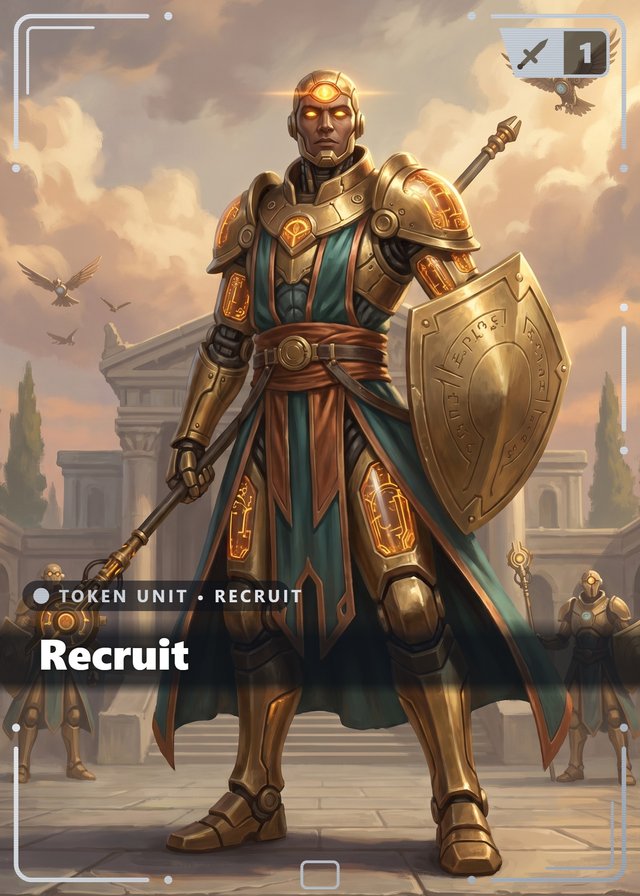
Most token shopping starts from the wrong end. You look at what is for sale, pick the art you like, and find out at the table that half of it never comes into play while the one token your deck makes every game is the one you skipped.
The list you need is already sitting in your decklist. Riftbound decks create tokens through the cards in them, so the tokens a deck needs are fixed the moment the deck is built. This guide walks the seven token types, what creates each one, and how to turn a decklist into a short shopping list.
Read the decklist, not the catalog
Go through your deck and note every card that puts something onto the battlefield that is not a card from your deck. Those are your tokens. Two things are worth writing down for each one: the token's name, and whether more than one arrives at a time.
That second point decides quantity, which is the part most people get wrong. A token that arrives one at a time needs one card on the table. A token that arrives in threes needs three, or you are stacking dice on a single plate and losing the thing you paid for.
The seven token types
Every token in the game falls into one of these, and each one is created by cards in particular colors:
| Token | Type | Might | Created by decks running |
|---|---|---|---|
| Recruit | Unit Token | 1 | Yellow, Blue |
| Bird | Unit Token | 1 | Green, Yellow |
| Tentacle | Unit Token | 1 | Purple |
| Sand Soldier | Unit Token | 2 | Green |
| Mech | Unit Token | 3 | Red, Blue, Orange |
| Sprite | Unit Token | 3 | Blue, Green |
| Gold | Gear Token | none | any deck |
Unit tokens go to the battlefield and have Might. Gold is gear rather than a unit, which is why it has no Might and why it is not tied to a color: a deck of any colors can end up making it.
Practical consequence: Gold is the one token almost every collection wants, and it is the one people leave out because it does not feel like a creature. If you own a single token card, that is a defensible choice for which one.
Filter by your colors
Read the table by color and most of it disappears. A Green and Blue deck cannot make a Tentacle, so a Tentacle is not on your list no matter how good the art is.
Worked from the colors alone:
- Yellow and Blue can make Recruit, Bird, Mech, Sprite, and Gold.
- Red and Blue can make Mech, Recruit, Sprite, and Gold.
- Green and Yellow can make Bird, Sand Soldier, Recruit, Sprite, and Gold.
- Red and Purple can make Mech, Tentacle, and Gold.
- Orange and Red can make Mech and Gold.
Those are ceilings, not requirements. The colors tell you what your deck could make; the decklist tells you what it does make. A Red and Blue deck with no Mech creators does not need a Mech, and the fastest way to waste money on tokens is to buy to the color ceiling instead of to the list.
How many of each
Three quantities cover almost every deck:
- One for anything that arrives alone and stays: Gold, and most single unit tokens.
- Two or three for anything a single card makes in a batch.
- Four or more for Recruits in a deck built around them. Recruit is the token that turns up in volume, and the count is set by your highest-producing card, not by the average turn.
This is where the two materials split. Metal tokens are sold as single cards, at $14 for stainless steel and $19 for the brass finish, so quantity is a per-card decision. Card stock ships five to a pack for $19, which covers a batch-maker in one purchase.
A common split is metal for the one or two tokens that define the deck and card stock for the ones you need four of. The metal vs card stock guide covers that trade in more detail.
Matching the list to a set
Our sets are built per color pair, and each one covers the tokens that pair can create. Some examples from the shop:
- Clockwork Choir is a Yellow and Blue set: Recruit, Bird, Mech, Sprite, and Gold.
- Dreaming Glade is a Green and Blue set and one of the two widest we make, at six tokens: Recruit, Bird, Mech, Sprite, Sand Soldier, and Gold.
- Broken Sands is an Orange and Red set, and it is deliberately two cards: Mech and Gold. That pairing does not create more than that.
If your list matches a set, buying the complete set takes 18 percent off the individual card prices. If your list is two cards out of a five-card set, buying those two cards is the cheaper answer, and every set page lists its tokens so you can check before ordering.
Sets exist in two art styles, Cinematic and Inkbrush, and a token bought in one style matches every other token in that style. That matters more than it sounds once the tokens are on the table beside each other.
When your deck spans two sets
Three-color decks and decks that shift colors between games will produce a list that no single set covers. Two ways through it:
Buy per token. Pull the individual cards your list names, from whichever sets have them, in one art style. The look holds together because the style is consistent even when the sets are not.
Buy the set that covers the most and fill in. Cheaper if the set discount applies to most of your list, and it leaves you with spare tokens for the next deck.
Whichever way you go, keep the style consistent rather than the set. Two Cinematic tokens from different sets look like a matched pair. A Cinematic and an Inkbrush of the same token do not.
A worked example
A Yellow and Blue deck making Recruits three at a time, one Mech per game, and Gold from a couple of cards. The list is:
- Recruit, three copies. A card stock five-pack at $19 covers it with two spare.
- Mech, one copy. Steel at $14.
- Gold, one copy. Brass at $19, since Gold is the token that reads best on the brass finish.
That is $52 and it covers every token the deck puts on the table. The complete Clockwork Choir set would be the move instead if you wanted the Bird and Sprite as well, at 18 percent off the individual prices.
The short version
Write the token list from your decklist, not from the shop. Use your colors to rule types out. Set quantity by the card that makes the most at once, which usually means card stock for Recruits and metal for the rest. Then check whether one set covers the list, and if it does not, keep the art style consistent instead of the set.
Once the list is settled, the table organization guide covers where the tokens should sit once you own them.